What Horror Has Become & What It Is Missing?
Has Physchological Thrillers Killed Slashers?
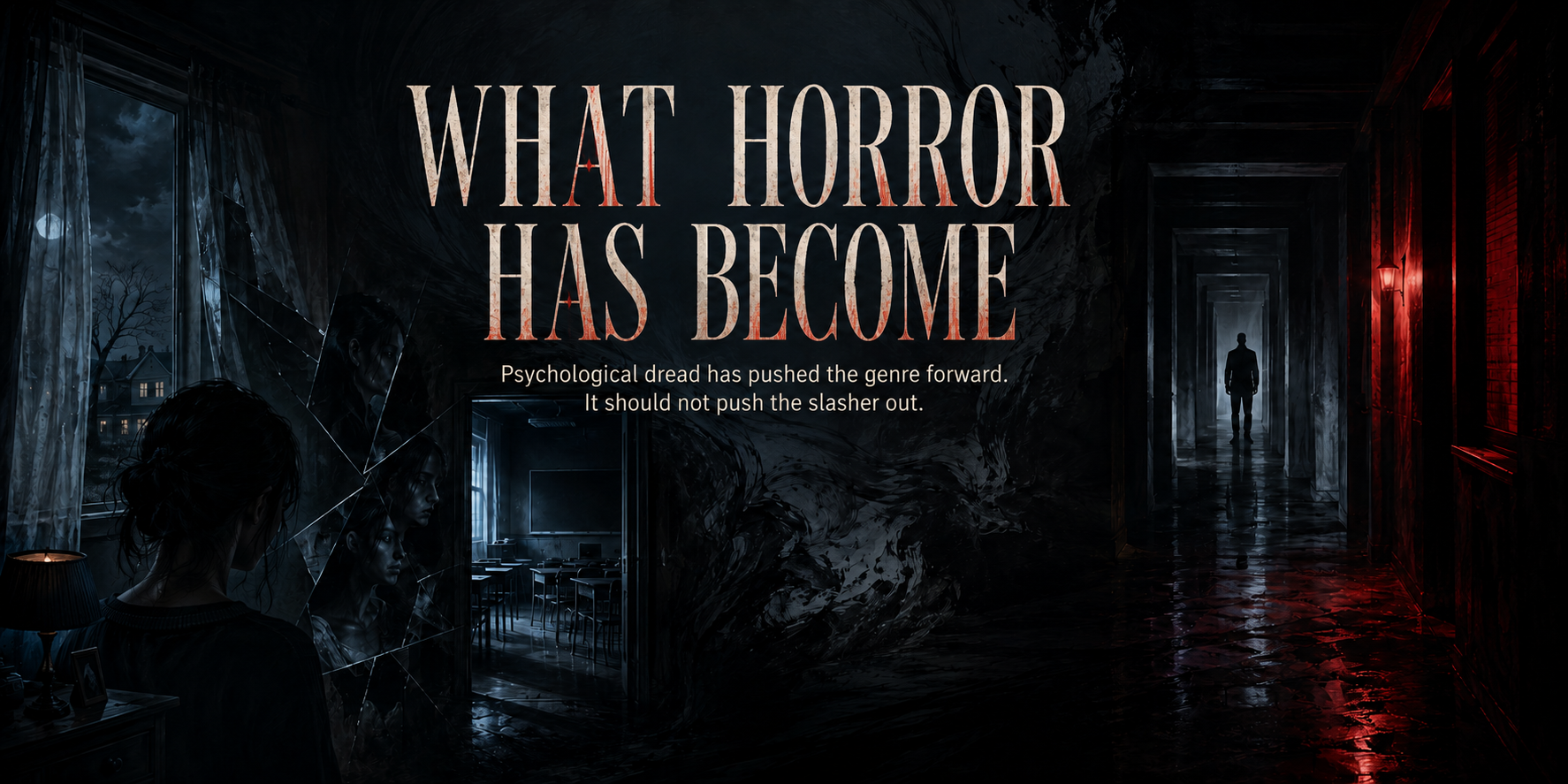
Horror has not disappeared. If anything, it has become one of the most flexible and ambitious genres in modern filmmaking. What has changed is the kind of fear many horror movies are most interested in creating. More and more, the genre leans toward grief, trauma, obsession, social anxiety, fractured families, unreliable memories, and mysteries that unfold slowly. These films are still sold as horror, but they often feel closer to psychological thrillers with supernatural or grotesque elements layered on top.
That is not necessarily a complaint. Movies such as Weapons and Obsession are not terrible films that need to be pushed out of the genre. They are proof that horror can be inventive, thoughtful, strange, and willing to take risks. But after watching enough movies built around atmosphere, symbolism, and emotional damage, I sometimes miss the blunt thrill of a masked killer, a vulnerable group of characters, a dark location, and a chase that makes the theater hold its breath.
Horror Learned to Linger
The recent wave of horror often wants fear to stay in the mind longer than it stays on the screen. Weapons begins with the disappearance of nearly an entire classroom and builds its terror through mystery, community panic, suspicion, and shifting points of view. The horror comes not only from what happened, but from the way uncertainty poisons everyone left behind. It is a horror story, certainly, yet its engine is closer to an intricate psychological mystery than to the clean pursuit structure of a traditional slasher.
Obsession works in a similar borderland. Its supernatural premise begins with a wish meant to force romantic love, then turns desire into control, dependence, and nightmare. Even when the movie becomes bloody or physically disturbing, the central fear is psychological: What happens when affection is manufactured, consent is ignored, and fantasy becomes a prison? The genre label fits, but the movie is less interested in a killer stalking victims than in a destructive idea tightening around its characters.
There is real value in that kind of horror. It gives filmmakers room to explore complicated fears, and it gives audiences something to discuss after the credits. The problem is not that horror has become smarter. The problem is the assumption that a movie must disguise itself as a prestige drama or an elaborate puzzle before its scares can be taken seriously. Sometimes horror is allowed to be meditative, symbolic, and ambiguous. It should also be allowed to be fast, physical, vicious, and fun.
What the Slasher Gives Us
The classic slasher works because its rules are immediate. Someone is coming. The characters may not know who the killer is, why they have been chosen, or whether they can escape, but the danger has a body. It can step out of the shadows, appear at the end of a hallway, or stand silently outside a window. That physical presence creates a kind of suspense that symbolism alone cannot replace.
The great slashers understood how to turn a simple structure into mythology. Halloween made a pale mask and a slow walk terrifying. Friday the 13th transformed summer camp into a place where every cabin could hide danger. A Nightmare on Elm Street made sleep itself unsafe. The Texas Chain Saw Massacre turned isolation and relentless pursuit into something almost unbearable, while Child’s Play gave its killer a personality audiences could recognize instantly. These movies were not identical just because they involved bodies and blades. Each built a distinct world, rhythm, and monster.
Later films proved the formula could evolve without abandoning its pleasures. Scream gave the slasher self-awareness, sharp dialogue, and a mystery structure while still delivering stalking, chases, and memorable confrontations. I Know What You Did Last Summer tied its hook-wielding killer to guilt, secrecy, friendship, and the consequences of one terrible decision. The Strangers franchise stripped the premise down even further: ordinary people, an isolated home, and attackers whose lack of a satisfying motive makes them more frightening. These films have psychological ideas, but they do not forget to put danger in the room.
Done Before Is Not the Same as Dead
The usual argument against more slashers is that the genre has already done everything. We have seen the masks, the final girls, the cabins, the holidays, the prank gone wrong, and the last-minute reveal that the killer is still alive. But repetition has never disqualified another genre. Romantic comedies still bring two people together. Mysteries still begin with a crime. Action movies still build toward a confrontation. Westerns still return to lonely towns, damaged heroes, and violent reckonings. Familiar structure is not the enemy; lazy execution is.
A new slasher does not need to pretend the past never happened. It needs a strong setting, characters worth following, suspense that is allowed to build, and a killer with a visual or behavioral identity. It needs chase scenes with geography, not just frantic editing. It needs kills that serve tension rather than replace it. Most of all, it needs the confidence to be entertaining without apologizing for the fact that audiences recognize the ingredients.
There are also plenty of fresh places for the slasher to go. Technology changes how people can be watched, trapped, misled, or isolated. New social settings create new groups and conflicts. A slasher can explore celebrity, online identity, class, work culture, fandom, or the disappearance of privacy without turning into a two-hour lecture. The genre has always absorbed the fears of its moment. It can do that again while keeping the mask, the chase, and the final confrontation.
Make the Killer Memorable Again
Part of what I miss is the excitement of a new horror villain becoming recognizable. The classic killers were not frightening only because of how many people they killed. They had silhouettes, sounds, movements, weapons, and rules. You could identify them from a shadow or a few notes of music. Modern horror has produced plenty of disturbing forces, but fewer figures designed to return, evolve, and become part of the genre’s shared language.
That does not mean every new slasher must launch a ten-film franchise. It means filmmakers should think about iconography again. Give us a villain whose presence changes the temperature of a scene. Give us victims who make choices, fight back, and surprise us. Give us a final survivor whose victory costs something. Use practical effects when they make the violence feel tangible, but remember that the best slashers create dread before the weapon ever lands.
The slashers I return to are not comforting because they are harmless. They are comforting because they understand the experience they promise. They turn fear into a roller coaster: anticipation, shock, release, and the nervous laugh that comes after surviving a scene from the safety of a seat. That communal pleasure is not less meaningful than the slow ache of psychological horror. It is simply a different use of the genre.
There Is Room for Both
Horror does not have to choose between the mind and the knife. Weapons, Obsession, and other psychologically driven films can continue expanding what horror is able to discuss and how it can tell a story. At the same time, studios and independent filmmakers can make room for more direct slashers—not only remakes and legacy sequels, but original killers, new survivors, and stories built to make an audience jump, cheer, and look over its shoulder on the way home.
The slasher has been done many times because the form works. The challenge is not to abandon it. The challenge is to do it with style, patience, personality, and conviction. Horror has become broader, more psychological, and more respectable. That growth is worth celebrating. But every now and then, it would be nice for horror to stop asking us to interpret the darkness and let something unforgettable step out of it.
Recent STories